Choosing a pet urn in Omaha
By our count, roughly 15,000 Omaha families say goodbye to a dog or cat each year. This is a plain guide to the urn that comes next: size, material, cost and delivery.
- Honest price ranges for Omaha
- Indoor and outdoor options for your climate
- Scattering basics for Nebraska
Omaha, Nebraska
Where families in Omaha find their urns
Great Plains families often want memorials that feel solid and lasting, and in Omaha many choose a granite stone in the garden, an urn at home next to family photographs, or a pendant holding a little ash. A framed paw print keepsake is another common way to keep a pet part of the household. For families who may move for work, a portable urn means the memorial goes wherever they do.
Nebraska's cremation rate for people is lower than on the coasts, and burial traditions remain strong in many Omaha families, especially those with farm roots in Nebraska or western Iowa. Some prefer to bury a pet on family land where the rules allow, perhaps near a farmhouse where they grew up. Others choose cremation so the ashes can move with them or be shared among family members in small keepsakes.
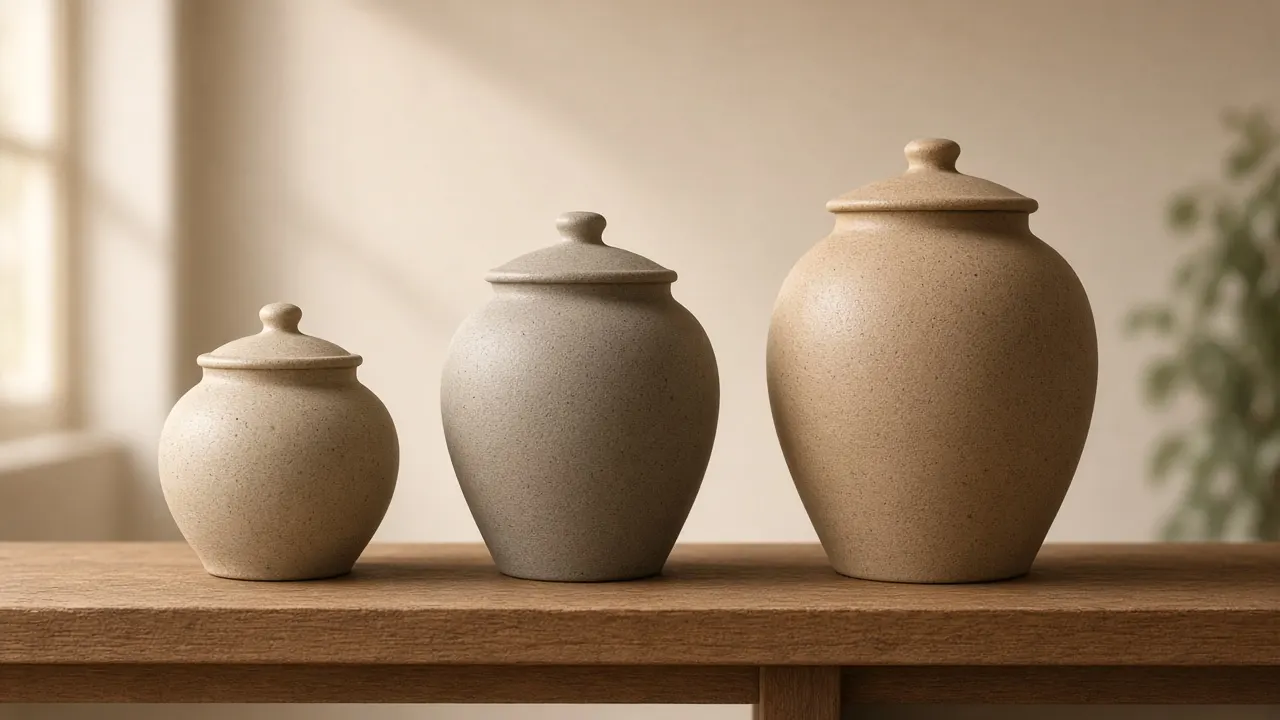
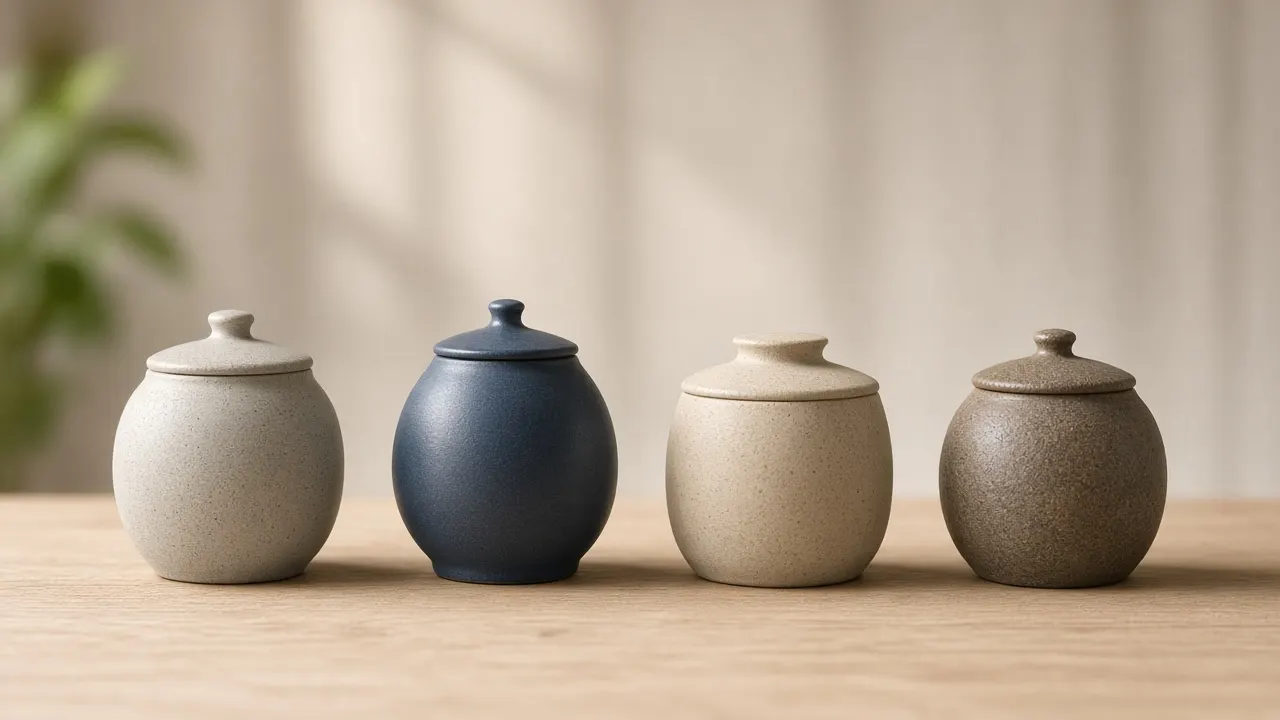
Families in Omaha are often spread across a few towns or states, which makes sharing ashes a practical question as much as an emotional one. A matching set of small keepsake urns lets a sibling in another city or a grown child who's moved away keep a portion. Decide how many shares you need before choosing the main urn, because every share you set aside changes the size it needs to be.
About 488,797 people live in Omaha, which makes it the largest of the 11 Nebraska communities we cover.
Nearby, we also have local pages for Council Bluffs (4 miles), Bellevue (7 miles) and Papillion (11 miles), which can help if your vet or the provider you prefer is based there.
Our estimate
180,000
Estimated dog- or cat-owning households in Omaha
How we calculated this
488,797 ÷ 2.5 = 195,519 households; × 53% (dog) + 39% (cat) = 180,000. Homes are counted once however many pets they keep.
Our estimate
15,000
Estimated dog and cat losses in Omaha each year
How we calculated this
180,000 dog/cat-owning homes ÷ average lifespan (dog: 12.69 yrs + cat: 11.18 yrs) ≈ 15,000 a year. Treat it as a minimum.
53%[1]
53% of US households own a dog, which is about 71 million households.
12.69 years[2]
US dogs have an average life expectancy at birth of 12.69 years.
39%[3]
39% of US households own a cat, which is about 53 million households.
11.18 years[4]
US cats seen at Banfield hospitals have an average life expectancy at birth of 11.18 years.
Where these figures come from: Montoya et al. 2023, Frontiers in Veterinary Science and American Pet Products Association (APPA) 2025 State of the Industry.
Keeping ashes at home: the local attitude
In Nebraska, about 62.2%[5] of people are cremated. That middle-ground rate means many families are choosing an urn for the first time, with no older relative's urn to copy. If that's you, start simple: know the capacity you need, decide whether it's for display or for burial and give yourself time. The urn size calculator turns your pet's weight into a capacity in seconds.
The Nebraska figure comes from NFDA 2024 Cremation & Burial Report state projections (via Occasional Sage) (2024). It describes people, not pets, so read it as a sign of local attitudes rather than a pet statistic.
Indoor and outdoor urns in Omaha's climate
Indoor heating matters as much as the cold outside. Forced-air vents and radiators dry the air, and a wooden urn placed right next to one can shrink, crack or open at the joints. Keep wooden urns a few feet from heat sources and out of the path of hot air. Metal, stone and ceramic don't mind dry air, which is one reason they're popular in cold places.
Freeze and thaw are hard on some urn materials left outdoors. Water that seeps into unglazed ceramic, terracotta or porous stone expands when it freezes and can crack the piece over one winter. If the urn will live outside in Omaha, choose granite, sealed stone or metal rated for outdoor use, or bring it indoors for the 5 coldest months.
How much to budget for an urn
Keepsakes are cheaper than you might think, and the sets are cheaper still. Keepsake or mini pet urns typically cost $15–$60[6] (per one large retailer); one widely cited figure puts a single keepsake at about $28 and a set of six at about $115[7]. Watch out for tiny premium pieces, though: at one crematory, a 1 oz heart keepsake cost about a third more than its full-size wooden urn[8].
For a line-by-line price table, see the Nebraska overview; for what's included in each option, see our services.
Free tool
Memorial budget planner
Add up cremation, urn, keepsakes and a farewell so the total holds no surprises.
Scattering and burial rules in Nebraska
Water is the place families ask about most. Scattering on a lake, a river or the sea feels natural to many people, but local authorities and park managers can have their own requirements, and some ask that only water-soluble urns are used. The general notes for Nebraska follow; whoever manages that stretch of water has the final say.
The official Nebraska local government directory lists every county and city office, which is the quickest way to find who to ask in Omaha.
Start with the Nebraska rules, which cover burial, scattering and oversight for the whole state, and treat Omaha's local ordinances as a possible extra layer.
What to do first, and what can wait
- Decide whether the urn is for display, burial or travel. That one choice rules out half the options.
- For display, pick something whose finish works with the room's light and decor, in a capacity that matches the ashes closely.
- For burial, pick something that breaks down naturally or a sealed box, having confirmed what Nebraska rules and the landowner allow.
- For travel, a wooden urn or another robust container that X-ray can see through is the safe pick, kept in your carry-on.
- Order engraving with a written proof; expect a longer wait for photographs or bespoke designs.
- Tell us what you're looking for through the contact form, and we'll email options that deliver to Omaha.
Sharing a pet's memory across the family
Omaha's long freeze-thaw winters can crack soft stone and heave markers out of the ground by spring. Granite, slate and cast metal last far better than concrete or painted wood. If you plant a memorial tree, choose a hardy species such as a native oak or redbud, and plant in spring so it can establish before summer heat and the next winter's cold. A planter by the front steps suits smaller yards.
go deeper with the guides or catch up on recent articles, use the free tools before you ring anyone, or compare your instinct with the poll results, For a plain comparison of the choices, open services. If you live between Omaha and Norfolk, Lincoln, Bellevue and Fremont, either page applies. Every other community in Nebraska, and all of the United States, is listed too.

Reader polls
What would you choose?
Vote anonymously and see how other readers answered. The results are live counts from people who visit this site, so they show real opinions, not a scientific sample.
Where does (or will) your pet's urn live?
Tap an answer to vote and see how others answered. Anonymous.
Will your pet's ashes stay together or be shared?
Tap an answer to vote and see how others answered. Anonymous.
If you had to decide today, which aftercare would you choose for your pet?
Tap an answer to vote and see how others answered. Anonymous.

Free tools to help you plan
Memorial budget planner
Add up cremation, urn, keepsakes and a farewell so the total holds no surprises.
Urn size calculator
Find the urn volume you need from your pet's weight, plus keepsake and sharing options.
Ashes sharing planner
Split ashes fairly between family members, keepsake urns and jewelry.
Questions people ask
How do Nebraska attitudes to cremation compare?
NFDA 2024 Cremation & Burial Report state projections (via Occasional Sage) (2024) puts the Nebraska human cremation rate at about 62.2%[5]. We show it on the Omaha page because pet aftercare choices tend to track it: where cremation is normal for people, communal and private pet cremation are both easy to find.
When is the hardest time of year to arrange a burial in Omaha?
January, February, March, November and December: average lows are below freezing then, and frozen ground makes a home grave slow or impossible until it thaws. The other pressure point is July, when highs around 88°F mean a body needs cooling and collecting quickly.
Roughly how many pets die in Omaha each year?
Our estimate is around 15,000. It comes from Omaha's population (about 488,797), the average household size, the share of homes with a dog or cat (about 180,000 households here) and the average lifespan. It is arithmetic, not a count, so read it as a rough floor.
Which nearby towns can I compare with Omaha?
The closest communities we cover are Council Bluffs (about 4 miles), Bellevue (about 7 miles) and Papillion (about 11 miles). Providers based in those places often serve Omaha too. Ask each one for a written total that includes collection, so the distance is priced in.
Can I mail my pet's ashes to a relative from Omaha?
Within the US, the Postal Service is the only national carrier that accepts cremated remains, and it requires Priority Mail Express with a special label. Pack the ashes in a sealed inner container, cushioned inside a sturdy box. Sending an empty keepsake urn is much simpler: many families post the urn and pass on the ashes in person.
Can I scatter my pet's ashes in a park near Omaha?
Often you can, but parks set their own rules, and some ask you to request permission first. Choose a quiet spot away from paths, playgrounds and water intakes, scatter close to the ground and downwind, and leave nothing behind. If you're unsure, check with the parks department or scatter on private land with the owner's agreement.


Sources and our estimates
- [1] 53% of US households own a dog, which is about 71 million households. American Pet Products Association (APPA) 2025 State of the Industry, 2025.
- [2] US dogs have an average life expectancy at birth of 12.69 years. Montoya et al. 2023, Frontiers in Veterinary Science - Banfield Pet Hospital life expectancy tables (13.3 million dogs, 2.4 million cats, 2013-2019), 2023.
- [3] 39% of US households own a cat, which is about 53 million households. American Pet Products Association (APPA) 2025 State of the Industry, 2025.
- [4] US cats seen at Banfield hospitals have an average life expectancy at birth of 11.18 years. Montoya et al. 2023, Frontiers in Veterinary Science - Banfield Pet Hospital life expectancy tables (13.3 million dogs, 2.4 million cats, 2013-2019), 2023.
- [5] The NFDA projected Nebraska's cremation rate at 62.2% for 2024. NFDA 2024 Cremation & Burial Report state projections (via Occasional Sage), 2024.
- [6] Keepsake or mini pet urns cost about $15–$60, versus $25–$100 for small and $40–$200 for medium urns (Memorials.com). Memorials.com – Pet Urn Cost Guide, 2025.
- [7] A single keepsake urn costs around $28 and a set of six around $115, per U.S. Funerals Online figures cited by Funeral.com. Funeral.com – How Much Do Cremation Urns Cost in 2025, 2025.
- [8] A 1 oz keepsake urn can cost about a third more than a full-size wooden urn at the same crematory. Our estimate: CA$106 heart keepsake / CA$79 solid wood urn. How we calculate.
- [9] Name-and-dates engraving adds about 36% to the price of a mid-priced wooden pet urn. Our estimate: midpoint engraving $32.50 ($25–$40) / midpoint wood urn $90 ($30–$150). How we calculate.
Get help choosing your pet's urn
Tell us what you need and where you are. We'll reply by email with clear options and prices so you can decide in your own time.