How big an urn does your pet need?
Urn makers allow one cubic inch of space per pound of body weight, even though the ashes themselves weigh only about 3-5% of body weight[1]. The calculator does the math and adds headroom.
- Capacity in cubic inches and milliliters
- Sizes for one urn or several shared ones
- Tells you which standard size to shop for
Urn size calculator
Enter your pet's healthy adult weight. We size the urn using the industry rule of 1 cubic inch per pound, plus 10% room to spare.
Recommended urn size
55 cu in (901 mL)
Look for: Medium (up to 60 cu in)
| Total ashes (by volume) | 50 cu in (819 mL) |
|---|---|
| Expected ash weight | 1.5 lb–2.5 lb |
| Urn with 10% margin | 55 cu in (901 mL) |
Standard sizes: small up to 20, medium up to 60, large up to 120 and extra large 200+ cubic inches. If you're between sizes, choose the larger one.
Source: Embrace Pet Insurance - Bury or Cremate Your Dog? Costs, Pros & Cons; Our estimate. 1 cu in per lb is an industry rule of thumb
Next step: Find urns and prices near you →
Using the calculator
How to use the urn size calculator
- Enter your pet's healthy adult weight in pounds or kilograms. If your pet lost weight during a long illness, use their usual weight from before, since bone mass, not body fat, drives the volume of ashes.
- Set how many households are sharing. Leave it at one if all the ashes will go in a single urn.
- Check the keepsake box if each person would also like a small keepsake urn of about three cubic inches.
- Read the recommended size and the standard category to look for: small, medium, large or extra large.
The result updates as you type, so you can try different sharing plans in a few seconds. Nothing is saved or sent anywhere. If you're unsure of the weight, your vet's records or the cremation paperwork will have it.
The math
How the calculator works out the capacity
It uses the rule of thumb the urn trade relies on: one cubic inch of space per pound of body weight. Cremated remains weigh about 3-5% of body weight[1], but they're light and bulky for their weight, and the volume rule reflects that. Because pets vary, the calculator then adds 10% so the sealed bag fits comfortably and the lid closes without force.
12 cu in (cat); 70 cu in (dog)[2]
If you choose to share, it first sets aside three cubic inches for each keepsake urn, divides what's left equally between the households, and adds the 10% margin to each share. It also converts everything to milliliters, since sellers outside the US often list capacity in metric units. One cubic inch is about 16.4 mL.
| Category | Capacity | Typical pets |
|---|---|---|
| Small | up to 20 cu in | Cats, rabbits, toy breeds |
| Medium | up to 60 cu in | Terriers, spaniels, Beagles |
| Large | up to 120 cu in | Labradors, retrievers, shepherds |
| Extra large | 200 cu in and up | Mastiffs, Great Danes, Newfoundlands |
Two public references sit behind these numbers. The NIST unit conversion tables give the 16.387 mL-per-cubic-inch factor behind the milliliter figure, and a study of 100 commercial cremations shows why a margin matters: even among adults of similar build, the weight of remains varied widely.
Worked example
A worked example: a Labrador, a family of three
Take a 70 lb Labrador. On its own, the rule gives 70 cubic inches; with the 10% margin that's 77 cubic inches, or about 1,260 mL. That sits comfortably in the large category, so a standard large urn of around 100 to 120 cubic inches leaves plenty of room.
Now say three grown-up children each want part of their dog, plus a keepsake. The calculator reserves 9 cubic inches for three keepsakes, leaving 61 to divide. Each household's share is about 20 cubic inches, so with the margin each needs an urn of roughly 22 cubic inches: a medium urn, or a generous small one. That's a very different shopping list from one big urn.
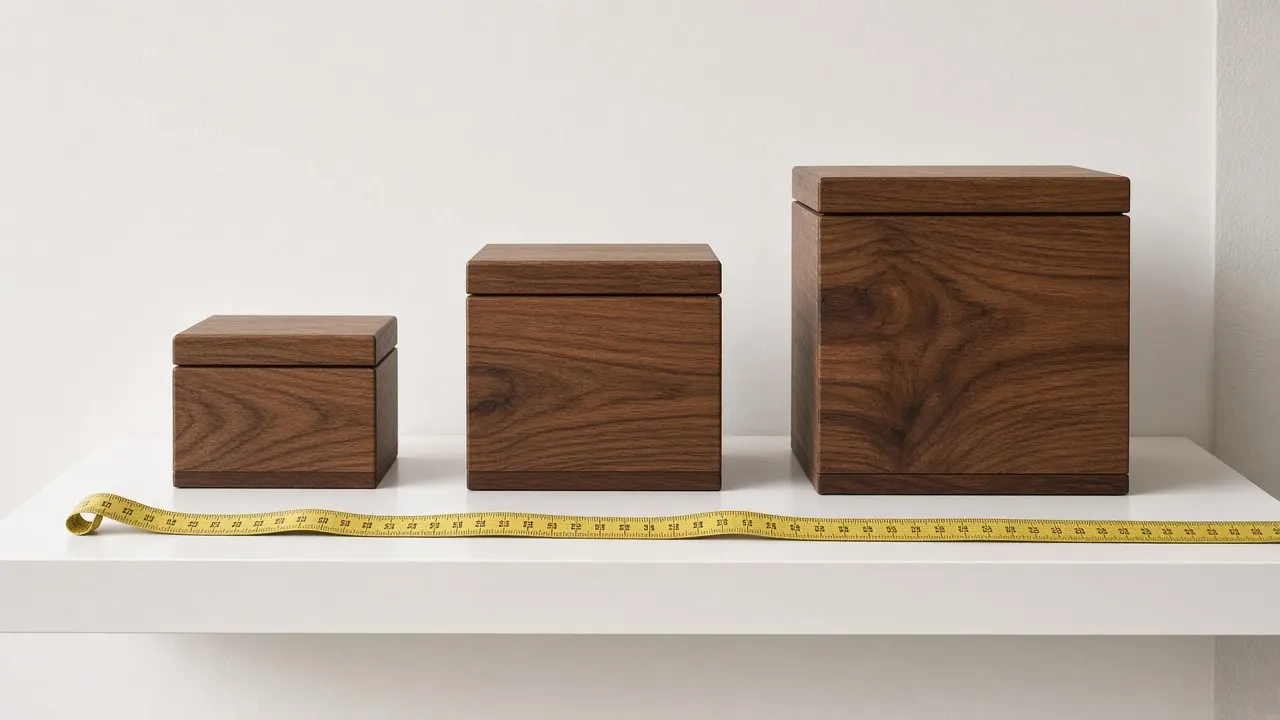
For a 12 lb cat, the answer is about 13 cubic inches, a small urn. For a giant breed around 108 lb, which returns about 3.8 lb[3] of ashes, you need 119 cubic inches or more, right at the top of "large". If you're between sizes, go up.
Your result
What your result means when you shop
Use the number in cubic inches, not the word "large", when comparing listings. Sellers are inconsistent: one shop's large is another's medium. Look for the internal capacity, because a thick-walled stone or wooden urn can hold much less than its outside size suggests.
Then check the opening. Many families leave the ashes in their sealed bag and place the bag inside the urn, which is much easier through a wide base panel than a narrow vase neck. Our post on checking capacity and the urn opening explains how to measure both. Once you know the size, compare urn materials to narrow the style.
What worries you most about ordering an urn online?
Tap an answer to vote and see how others answered. Anonymous.
Limits
What the calculator can't tell you
It can't measure your pet's actual ashes. Bone density, age, breed and how finely the crematory processes the remains all shift the real volume. A 30 kg dog, for example, can leave anywhere from about 0.9-1.5 kg[4] of remains by our estimate. The margin covers most of that variation, not all of it.
It also can't judge very small pets well. Hamsters, finches and small reptiles may return only a spoonful, and sometimes less than the rule suggests. For those, a keepsake-sized urn is usually right. If the ashes are already home, weigh the sealed bag or look at the temporary container; that's more accurate than any estimate. The ashes weight estimator gives you a range to compare against.
Next steps
What to do once you have the size
With a capacity in hand, the rest of the choice gets easier. If several people want a share, the ashes sharing planner lets you mix keepsake urns, pendants and scattering tubes. If you'd like a clear total, add the urn to the memorial budget planner; one industry report says personalized pet urns range from about USD 50–1,000+[5].
Free tool
Ashes sharing planner
Split ashes fairly between family members, keepsake urns and jewelry.
Or send us your result with the style you like, and we'll reply by email with urns whose capacity the seller has confirmed.

Reader polls
What would you choose?
Vote anonymously and see how other readers answered. The results are live counts from people who visit this site, so they show real opinions, not a scientific sample.
Will your pet's ashes stay together or be shared?
Tap an answer to vote and see how others answered. Anonymous.
What worries you most about ordering an urn online?
Tap an answer to vote and see how others answered. Anonymous.
Do you keep more than one memorial for the same pet?
Tap an answer to vote and see how others answered. Anonymous.

Free tools to help you plan
Urn size calculator
Find the urn volume you need from your pet's weight, plus keepsake and sharing options.
Ashes sharing planner
Split ashes fairly between family members, keepsake urns and jewelry.
Ashes weight estimator
See roughly how much ash to expect back, by species and body weight.
Questions people ask
What if my pet's weight is somewhere in between sizes?
Choose the larger size. An urn with spare room closes easily and still looks right on a shelf, while an urn that's even slightly too small means keeping some ashes elsewhere or buying again. Extra space inside is invisible once the lid is on.
Should I use my pet's weight at the end of their life?
Use their normal healthy adult weight. Pets often lose fat and muscle during a long illness, but bone mass changes far less, and bone is what remains after cremation. Sizing from a lower end-of-life weight can leave you with an urn that's too small.
Is the one-cubic-inch rule the same in metric?
Yes, just converted. One cubic inch per pound works out to about 36 milliliters per kilogram. A 20 kg dog therefore needs roughly 720 mL before headroom, or about 800 mL with the 10% margin. The calculator shows both units automatically.
Can a keepsake urn hold all of a small pet's ashes?
Often, yes. Keepsake urns hold roughly one to five cubic inches, which can be enough for a hamster, budgie or small reptile. A cat or rabbit usually needs a small urn of 10 to 20 cubic inches instead. Check the keepsake's listed capacity against your calculator result.
Do figurine urns follow the same sizing?
They should, but check carefully. Figurine urns hide their compartment in the base, so the internal capacity can be much smaller than the sculpture suggests. Compare the listed cubic inches with your result before ordering, especially for medium and large dogs.


Sources and our estimates
- [1] Embrace notes cremated remains typically weigh about 3-5% of the pet's original body weight. Embrace Pet Insurance - Bury or Cremate Your Dog? Costs, Pros & Cons, 2025.
- [2] Using the industry rule of thumb of 1 cubic inch of urn space per pound of body weight, a 12 lb cat needs an urn of about 12 cubic inches; a 70 lb dog needs about 70 cubic inches. Our estimate: urn cu in = body weight lb x 1 (industry rule of thumb, not a measured value). How we calculate.
- [3] A median-weight giant-breed dog (48.8 kg / 108 lb) would be expected to return about 1.71 kg (3.8 lb) of cremated remains, needing an urn of about 108 cubic inches. Our estimate: 48.8 kg x 3.5% x 2.2046 lb/kg; urn = 108 lb x 1 cu in/lb. How we calculate.
- [4] A 30 kg (66 lb) dog typically leaves about 0.9-1.5 kg of cremated remains, which helps size urns on location pages. Our estimate: 30 kg x 3% = 0.9 kg; 30 kg x 5% = 1.5 kg. How we calculate.
- [5] Personalized pet urns range from about USD 50 to more than USD 1,000. Astute Analytica via GlobeNewswire — Global Pet Preservation Services Market to Hit USD 112.7 Million by 2032 (Apr 2, 2024), 2024.
Get urns in the right size
Tell us what you need and where you are. We'll reply by email with clear options and prices so you can decide in your own time.