Finding the right pet urn near Oregon
Oregon has an estimated 7,250 dog- or cat-owning households. When a pet's ashes come home, the urn is often the last thing chosen and the thing kept longest. Here's how to get it right.
- Wood, ceramic, marble and brass compared
- Tips for moving ashes safely
- Ideas for apartments and houses

Oregon, Ohio
How Oregon families shop for a pet urn
Western Lake Erie's back-and-forth between frost and thaw tilts stones and flakes softer materials. Granite set over crushed stone lasts far longer. The heavy, wet soils near the marshes suit trees such as swamp white oak or river birch, if ashes are to be planted with one; April or October gives roots an easy start. Water through dry spells.
Some Oregon households mark each spring migration as a time to remember, adding a new native plant or refilling a memorial feeder when the warblers return. Rituals like that give grief a place in the calendar. If you want an inked pawprint or saved fur, though, ask the provider promptly, because neither is possible once cremation has happened. Other decisions can hold until the ice breaks up on the bay.
If you live near Oregon but work or shop in Toledo, it may be simpler to have the urn delivered there, or to choose one in person at a crematory or memorial supplier in the larger centre. That's especially true for heavy pieces like marble or granite. Just ask for the exact capacity in cubic inches before you drive anywhere, so you know it will fit the ashes you have.
About 19,674 people live in Oregon, which makes it the 89th-largest of the 106 Ohio communities we cover. Toledo, roughly 5 miles off, is the closest larger centre, and a share of the providers who cover Oregon run from there.
The closest communities we cover are Toledo (5 miles, a larger centre), Perrysburg (13 miles) and Sylvania (15 miles). Providers serving those towns often travel to Oregon too, so it can be worth asking them for a quote.
Our estimate
7,250
Estimated dog- or cat-owning households in Oregon
How we calculated this
19,674 ÷ 2.5 = 7,870 households; × 53% (dog) + 39% (cat) = 7,250. Multi-pet homes count once.
Our estimate
600
Oregon families who lose a dog or cat each year (estimate)
How we calculated this
7,250 dog/cat-owning homes ÷ average lifespan (dog: 12.69 yrs + cat: 11.18 yrs) ≈ 600 a year. The real figure is unlikely to be lower.
53%[1]
53% of US households own a dog, which is about 71 million households.
12.69 years[2]
US dogs have an average life expectancy at birth of 12.69 years.
39%[3]
39% of US households own a cat, which is about 53 million households.
11.18 years[4]
US cats seen at Banfield hospitals have an average life expectancy at birth of 11.18 years.
Where these figures come from: American Pet Products Association (APPA) 2025 State of the Industry and Montoya et al. 2023, Frontiers in Veterinary Science.

Why urns are common in Ohio
Cremation is common but not universal in Ohio, where about 59.1%[5] of people are cremated. Pet crematories here usually sell a solid core range of urns rather than a huge catalog, so families who want something unusual, like a figurine or a marble urn, often buy online. The local range is still worth seeing first, since those urns are chosen to fit the ashes that crematory returns.
Source for the Ohio number: NFDA 2024 Cremation & Burial Report state projections (via Occasional Sage) (2024). Nobody publishes a pet cremation rate for Oregon, so the human figure is the best local signal available.
Indoor and outdoor urns in Oregon's climate
Oregon winters bring average lows at or below freezing in January, February, March and December. If you'd like to bury your pet's ashes in the garden, frozen ground may mean waiting until spring. That's fine: the ashes are safe indoors in the temporary container or the urn, and many families find a spring burial, with the first flowers coming up, a gentler moment than a cold graveside in January.
Cold months are a good time for indoor decisions. The 4 months with freezing lows are when many Oregon families settle on the urn, order engraving and plan a spring planting or scattering. Doing the choosing indoors in winter means that when the ground thaws, everything is ready, and the day itself can be about your pet rather than errands.
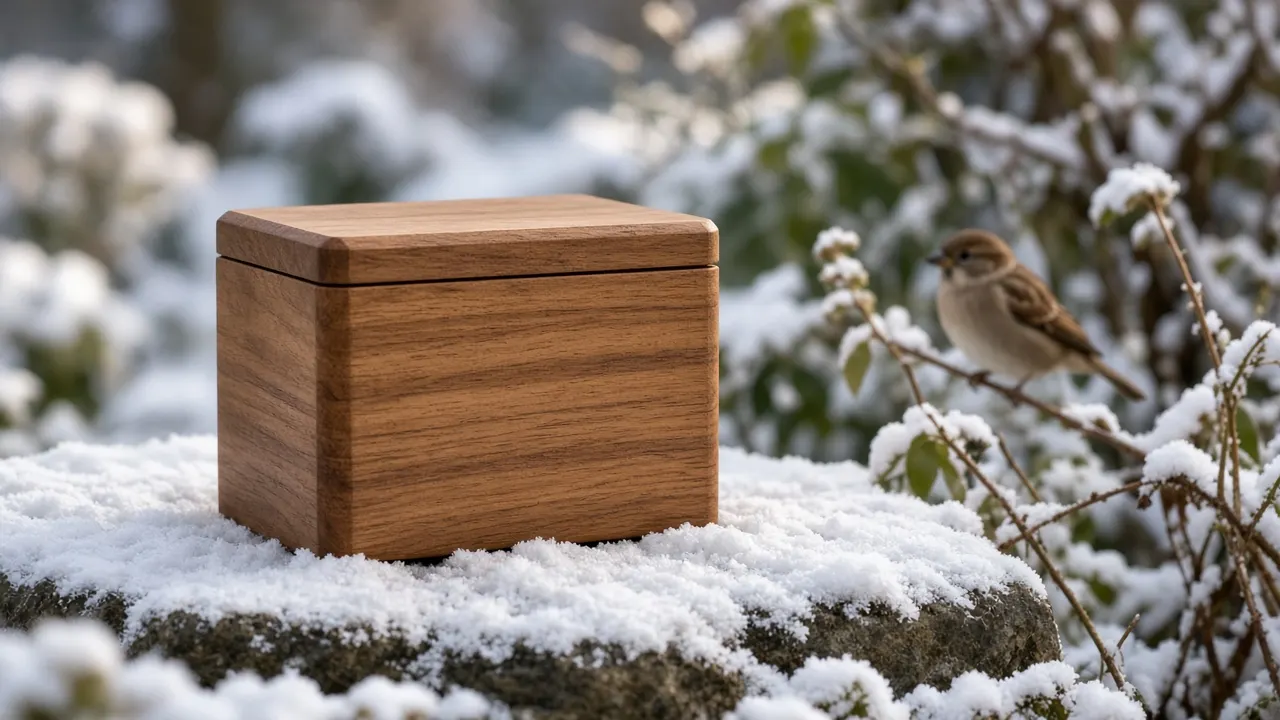
What pet urns cost in Oregon
Pet urns are a real part of what families spend after a loss: one industry report says they generate over 40% of pet memorial product revenue[6]. It's worth spending carefully rather than quickly. The ranges below come from national price guides and published crematory price lists; Oregon prices will usually fall inside them. Add delivery and engraving, then compare totals, not headline prices.
For a line-by-line price table, see the Ohio overview; for what's included in each option, see our services.

Free tool
Memorial budget planner
Add up cremation, urn, keepsakes and a farewell so the total holds no surprises.
Pet ashes and the law in Ohio
Nobody needs a permit to keep an urn on a shelf. Permission only comes into it once part of the ashes goes somewhere shared, such as a park, a beach, a river or a cemetery. Before any of that, find out who looks after the place you have in mind, since the answer usually comes from them rather than from a single law. The general picture for Ohio is below.
The official Ohio local government directory lists every county and city office, which is the quickest way to find who to ask in Oregon.
The rules that apply across Ohio (home burial, scattering and who oversees pet cremation) are summarized on our Ohio page. Oregon may add its own conditions, so check with the city or county before digging.
How to get from ashes to urn
- Give yourself a week or two before choosing. The first days are rarely the best time for design decisions.
- Picture where the urn will sit, and take a tape measure to it: depth of shelf, clearance under a cupboard, room on the mantel.
- Estimate the ashes. Roughly 3-5% of body weight[8] comes back as cremated remains; for a figure based on your own pet, try the ashes weight estimator.
- Decide on personalization, whether dates and a name, a photo, a paw impression or a plain surface.
- Order the main urn and any keepsakes together, then each piece shares one finish.
- Transfer the ashes over a tray, indoors and away from drafts, if the bag won't fit through the opening.
- Keep the crematory's certificate or label with the urn, tucked underneath or in a drawer nearby.
Remembering your pet, in Oregon and beyond
Oregon sits on one of the major bird migration routes along western Lake Erie, and some families choose memorials tied to that: a birdbath in the garden, a feeder beside a memorial stone, or native plants that draw songbirds in May. Others display an urn inside or wear jewelry holding some ash. The remains can be divided among several keepsakes.
there are guides for the big decisions and articles for the details, use the free tools before you ring anyone, Our services overview lays out every option side by side, or compare your instinct with the poll results. If you live between Oregon and Cincinnati, Cleveland, Akron and Dayton, either page applies. Every other community in Ohio, and all of the United States, is listed too.

Reader polls
What would you choose?
Vote anonymously and see how other readers answered. The results are live counts from people who visit this site, so they show real opinions, not a scientific sample.
Where does (or will) your pet's urn live?
Tap an answer to vote and see how others answered. Anonymous.
Will your pet's ashes stay together or be shared?
Tap an answer to vote and see how others answered. Anonymous.
If you had to decide today, which aftercare would you choose for your pet?
Tap an answer to vote and see how others answered. Anonymous.

Free tools to help you plan
Memorial budget planner
Add up cremation, urn, keepsakes and a farewell so the total holds no surprises.

Urn size calculator
Find the urn volume you need from your pet's weight, plus keepsake and sharing options.

Ashes sharing planner
Split ashes fairly between family members, keepsake urns and jewelry.
Questions people ask
Which nearby towns can I compare with Oregon?
The closest communities we cover are Toledo (about 5 miles), Perrysburg (about 13 miles) and Sylvania (about 15 miles). Providers based in those places often serve Oregon too. Ask each one for a written total that includes collection, so the distance is priced in.
Is Oregon big enough to have several pet aftercare providers?
Probably, on the numbers. By our estimate about 7,250 Oregon households keep a dog or cat and around 600 lose one each year, which is enough steady demand to support more than one provider. We derive that from population (about 19,674), household size and national ownership and lifespan figures.
Will I have to travel to Toledo to arrange things?
Not usually. Providers based in Toledo (roughly 5 miles from Oregon) collect from here as a matter of routine, and the paperwork is done by email or phone. If you want to be present for a witnessed cremation, that is when the drive matters.
Is cremation common in Ohio?
For people, yes: about 59.1%[5] of Ohio deaths end in cremation, according to NFDA 2024 Cremation & Burial Report state projections (via Occasional Sage) (2024). Nobody publishes the same figure for pets, but in our experience pet choices in Oregon follow the human pattern closely, so cremation is the default most families here start from.
Can I mail my pet's ashes to a relative from Oregon?
Within the US, the Postal Service is the only national carrier that accepts cremated remains, and it requires Priority Mail Express with a special label. Pack the ashes in a sealed inner container, cushioned inside a sturdy box. Sending an empty keepsake urn is much simpler: many families post the urn and pass on the ashes in person.
Is it safe to open the bag of pet ashes?
Yes. Cremated remains are dry, sterile bone fragments with no smell, and handling them carries no health risk. They're coarser and heavier than most people expect, a little like pale sand. If you do open the bag, work indoors over a tray, away from open windows and fans, and keep pets out of the room. Wash your hands afterwards, as you would after gardening.


Sources and our estimates
- [1] 53% of US households own a dog, which is about 71 million households. American Pet Products Association (APPA) 2025 State of the Industry, 2025.
- [2] US dogs have an average life expectancy at birth of 12.69 years. Montoya et al. 2023, Frontiers in Veterinary Science - Banfield Pet Hospital life expectancy tables (13.3 million dogs, 2.4 million cats, 2013-2019), 2023.
- [3] 39% of US households own a cat, which is about 53 million households. American Pet Products Association (APPA) 2025 State of the Industry, 2025.
- [4] US cats seen at Banfield hospitals have an average life expectancy at birth of 11.18 years. Montoya et al. 2023, Frontiers in Veterinary Science - Banfield Pet Hospital life expectancy tables (13.3 million dogs, 2.4 million cats, 2013-2019), 2023.
- [5] The NFDA projected Ohio's cremation rate at 59.1% for 2024. NFDA 2024 Cremation & Burial Report state projections (via Occasional Sage), 2024.
- [6] Pet urns generated over 40% of pet memorial product revenue in 2023. DataHorizzon Research — Pet Memorials Market report page, 2023.
- [7] Using the industry rule of thumb of 1 cubic inch of urn space per pound of body weight, a 12 lb cat needs an urn of about 12 cubic inches; a 70 lb dog needs about 70 cubic inches. Our estimate: urn cu in = body weight lb x 1 (industry rule of thumb, not a measured value). How we calculate.
- [8] Embrace notes cremated remains typically weigh about 3-5% of the pet's original body weight. Embrace Pet Insurance - Bury or Cremate Your Dog? Costs, Pros & Cons, 2025.
Ask for urn and keepsake ideas by email
Tell us what you need and where you are. We'll reply by email with clear options and prices so you can decide in your own time.